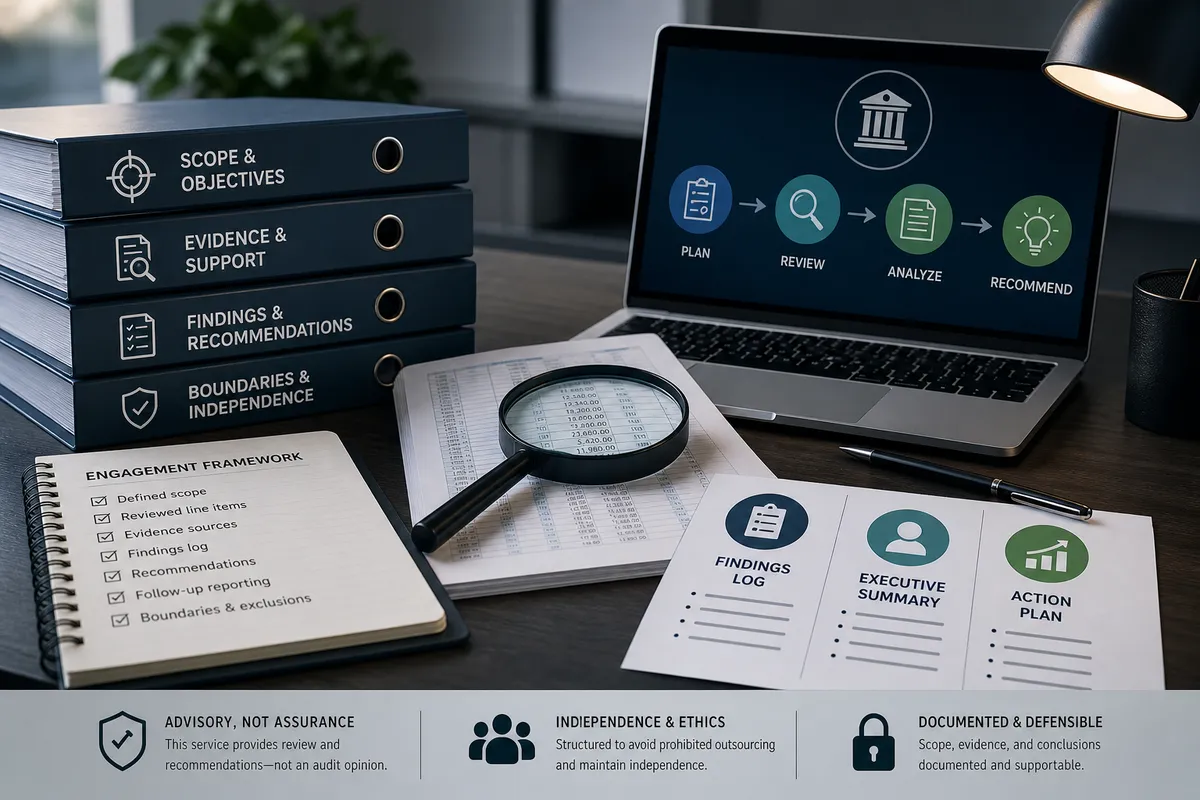
How Accounting Firms Can Package Line-Item Auditing as a Repeatable Advisory Service
Accounting firms have clear reasons to look for more repeatable advisory work, but the available evidence supports a narrow thesis: if a firm wants to package line-item review into a recurring service, the defensible path is to standardize engagement mechanics, not to blur the line with assurance. The source record is useful on planning, evidence, reporting, and independence guardrails. It is much thinner on pricing, staffing, and packaging templates. That gap matters. A credible offering should therefore be framed as advisory review and recommendations, with documented scope, support for each finding, and explicit boundaries from an audit opinion or prohibited outsourcing arrangement.
Lede: advisory demand is rising, but packaging has to respect audit-role boundaries
A dated public signal for this topic exists. In a 2014 speech, the PCAOB described “the rise of the advisory and consulting services within accounting firms” and tied that trend to investor and stakeholder concerns about independence. The same speech also restated prohibited services under Section 201 of Sarbanes-Oxley, including bookkeeping for the audit client and internal audit outsourcing services. That does not answer every packaging question for a line item review service, but it does establish the guardrail that matters most: repeatability cannot come from implying assurance or stepping into roles the sources treat as off-limits.
That is the article’s thesis. Accounting firms can make line-item auditing more repeatable as an advisory service by standardizing scope, documentation, communication, and expectation-setting. The evidence supports those mechanics. It does not support broad claims about economics, turnaround, or a universal operating model.
Key Findings
- Public regulatory commentary has identified growth in advisory services within accounting firms while also emphasizing independence concerns.
- Audit planning sources support defining the accounts, transactions, period, and procedures to be reviewed before work begins.
- Evidence-gathering guidance supports tying findings to identifiable support such as source documents and transaction records.
- Reporting guidance supports structured outputs that state objectives, scope, methodology, findings, and recommendations.
- Communication guidance supports a cadence that includes kickoff, periodic updates, a final report, and follow-up reporting.
- The available sources do not provide a complete blueprint for pricing, staffing, or packaging line-item review across firms.
The practical implication is modest but useful. If firms want a repeatable advisory offer here, they should package the work around what the sources actually support: a documented review method, a plain-English scope, evidence-backed findings, and clear statements about what the engagement does not provide.
Key finding 1: repeatability starts with a documented methodology, not a vague promise to review spend
The strongest support for repeatability comes from methodology. The OCC handbook says methodology should ensure assessments are “consistent and repeatable,” and its discussion of continuous auditing points to formal practices for monitoring processes, transactions, and accounts over time, with results documented through metrics, management reporting, periodic summaries, and updated assessments. Even though that source addresses internal audit contexts, the narrower takeaway is still usable for advisory packaging: repeatability depends on a formal method and documented outputs.
For accounting firms, that means the service description should say what is being reviewed, over what period, and through what steps. The SVA audit guide supports this level of specificity by describing planning around accounts to focus on and procedures to investigate the accuracy of specific line items. It also describes evidence work such as tracing individual transactions to source documents and testing samples of reported items. Those are concrete building blocks for a repeatable advisory review.
What the evidence does not support is a proprietary-sounding promise to “review spend” without defining the method. The research packet is thin on staffing models, tiered packages, and workflow governance. So the safer interpretation is simple: standardize the review sequence, not the marketing claim.
What Changes on Monday
- Write a one-page methodology statement for the service.
- Define the review objective before discussing recommendations.
- State the population, period, and reviewed line items in every engagement.
- Describe the review steps in consistent language across clients.
A repeatable service starts to look credible when two different engagements can be described through the same method, even if the findings differ.
Founder perspective:
“Repeatability comes from a visible chain of custody: risk-based scope, transaction tracing, sampled testing, evidence logs, then findings that point to recommendations. Without that mechanism, a line-item review is just a recurring conversation with no defensible backbone.”
— James Scott, Founder, Embassy-Row-Project
Key finding 2: scoping should define objectives, reviewed line items, evidence sources, and exclusions up front
Scoping is where many advisory offers become vague. The approved sources support a tighter approach. The SVA guide says auditors assess business, industry, and company-specific risks to determine the accounts to focus on and develop procedures. It also gives examples of tracing transactions to sales contracts, bank statements, or purchase orders, and testing samples of reported items. That supports a scoping discipline built around objective, focus area, and evidence source.
For a line-item advisory review, the scope should therefore answer four questions at the start: what objective the review serves, which line items or account areas are being examined, what documents or data will be reviewed, and what is excluded. The evidence does not provide a full packaging framework, so this should stay at principle level rather than drift into unsupported thresholds or acceptance rules.
A compact scoping checklist fits the source record:
- Objective of the review
- Period covered
- Reviewed accounts, transactions, or line items
- Expected evidence sources
- Review procedures to be used
- Explicit exclusions and non-objectives
Strongest objection
If scoping becomes this detailed, the service may start to resemble an audit engagement too closely.
Reply
The distinction is not in whether the work is organized. It is in what the firm says the work is for and what it delivers. The sources support planning and evidence discipline. They also support a clear line between accounting services and audit functions. A documented scope can help preserve that line by stating, up front, that the engagement is an advisory review with findings and recommendations, not an audit opinion.
Detailed scoping does one more useful thing. It gives the client a shared understanding of what the service will not determine. Given the research gaps around assurance boundaries and packaging language, that restraint is part of the design.
Founder perspective:
“The contrarian move is to make the promise smaller and the method tighter: name the line items, period, source documents, and exclusions upfront, because vague advisory packaging creates more independence risk, not less.”
— James Scott, Founder, Embassy-Row-Project
Key finding 3: evidence standards should support findings and recommendations without implying an audit opinion
A repeatable advisory service needs evidence standards, but the standard should match the service. The Optro reporting article says findings should be supported by documented evidence such as data, documents, and observations, and that reports should include objectives, scope, methodology, findings with supporting evidence, conclusions, and recommendations. The SVA guide adds concrete examples of source support, including contracts, bank statements, purchase orders, and sampled items.
That is enough to support a practical rule: each finding should tie to identifiable support, and each recommendation should be traceable to that support. If a review flags a questionable line item pattern, the file should show what records were examined and how the observation was reached. That is different from implying an audit opinion on the financial statements as a whole.
The boundary matters because the same SVA source says there should be a clear line between accounting services and audit functions, and that auditors evaluate what exists rather than doing the accounting or reporting work. Applied cautiously, that suggests an advisory package should present supported observations and recommendations, while avoiding assurance language the sources do not establish.
How We Know
The evidence base here comes from the approved source set only: a PCAOB speech on advisory growth and independence concerns, an audit planning and evidence guide from SVA, the OCC handbook on repeatable methodology and documented outputs, an audit reporting article describing report structure and evidence support, and an internal-audit communication text on timing and audience. The method for this article is synthesis, not original reporting. The source window is uneven, and some materials are educational or vendor-authored rather than regulatory. The evidence supports planning, documentation, communication, and role-boundary points. It does not prove a complete packaging model, pricing approach, staffing design, or universal evidence threshold for advisory line-item reviews.
Founder perspective:
“An operator rule for this service is simple: if a finding cannot be tied back to a contract, bank statement, purchase order, sampled item, or documented observation, it should not survive into the client recommendation set.”
— James Scott, Founder, Embassy-Row-Project
Key finding 4: standardized deliverables matter most in findings logs, executive summaries, and follow-up reporting
The best-supported packaging choice in the research is deliverable structure. Optro says an effective report should communicate objectives, scope, and findings clearly, and notes that different audiences need different views. Executives may need a short summary, while managers and process owners need more detail. The eCampusOntario communication chapter supports a cadence that begins with initial communication on scope, objectives, and timeline, continues with periodic progress reports, and ends with a comprehensive final report plus follow-up communications on recommendation status.
That combination supports three standardized deliverables for a repeatable advisory service. First, a findings log that records each issue, the supporting evidence, and the related recommendation. Second, an executive summary that condenses the objective, scope, method, and major observations for leadership. Third, follow-up reporting that tracks the status of recommendations after the final report. The sources support these elements as communication and reporting mechanics, not as a claim that one template fits every engagement.
Source Notes
PCAOB on advisory growth and independence concerns: https://pcaobus.org/news-events/speeches/speech-detail/the-rise-of-advisory-services-in-audit-firms_544
SVA on planning around specific line items, tracing transactions, and maintaining a clear line between accounting services and audit functions: https://accountants.sva.com/a-guide-to-audits-prep-planning-and-post-audit-tips
OCC on consistent and repeatable methodology and documented outputs: https://occ.gov/publications-and-resources/publications/comptrollers-handbook/files/internal-external-audits/pub-ch-audits.pdf
Optro on report structure, supporting evidence, and audience-specific reporting: https://optro.ai/blog/4-key-resources-effective-audit-reporting
eCampusOntario on kickoff communication, periodic updates, final reporting, and follow-up communication: https://ecampusontario.pressbooks.pub/internalauditing/chapter/10-05-best-practices-in-audit-communication
The operational lesson is that packaging should be visible in the outputs. If the service cannot produce a consistent findings log, a concise executive summary, and a follow-up report, it is not yet standardized in a way the evidence clearly supports.
Conclusion
The source-backed case for packaging line-item auditing as a repeatable advisory service is narrower than many firms may want, but it is still useful. Standardize the method. Define scope plainly. Tie each finding to identifiable support. Communicate through a consistent set of deliverables, while stating clearly that the work is advisory review and recommendations, not an audit opinion or prohibited outsourcing arrangement. The research does not provide a full blueprint for pricing, staffing, or assurance wording, so firms should avoid overclaiming. Invite readers to evaluate whether their current client-review work could be turned into a more standardized advisory offering using a documented scope, findings format, and communication cadence.