How CPA Firms Can Build a Quality-Control Process for AI-Assisted Advisory Deliverables
Across 2025 and 2026 accounting guidance, the live question is less whether CPA firms will use AI in tax, audit, compliance, and advisory work, and more whether they can defend the review trail behind AI-assisted output. The available sources converge on a narrow thesis: firms do not need a complete end-to-end AI rulebook before they begin, but they do need a documented quality-control path built around reviewed inputs, evidence sufficiency, human judgment, and risk-based review. That matters for firms expanding AI-Powered Advisory Services, where client-facing language may be drafted quickly but still has to stand up to professional scrutiny.
Key Findings
- Recent accounting guidance places AI inside governance, supervision, documentation, and evidence standards rather than outside the firm’s quality system.
- The strongest source-backed starting point is a narrow use case with structured inputs and a reviewer who knows what a good answer looks like.
- Multiple sources identify completeness of data inputs and reliability of source data as review issues that must be checked before trusting AI output.
- Current guidance supports documenting material AI assistance and preserving enough context for peer review or reperformance.
- The evidence favors risk-based review depth over a blanket rule that every AI-assisted task needs the same level of signoff.
- The source set supports pilot testing and parallel validation more clearly than it supports a universal workflow template.
What the evidence says now: AI use is acceptable only inside a quality architecture
The clearest pattern in the source set is that AI is treated as a professional tool only when it sits inside the firm’s existing quality architecture. CalCPA describes AI use in tax and accounting research, document drafting, and analysis as subject to firm policies, professional expertise, judgment, and oversight. Thomson Reuters similarly ties technology-assisted work to reperformability, professional skepticism, validity, accuracy, and completeness. SkillAbility goes further by arguing that AI should be integrated into a risk-based quality-control framework rather than managed as a separate innovation project.
That is the dated finding here. Recent 2026 accounting sources are not framing acceptable AI use as a free-form productivity exercise. They are framing it as supervised work that still has to meet documentation and evidence expectations.
Interpretation matters, because the sources do not hand firms a single universal workflow. They support control points more strongly than they support a full operating manual. The defensible reading is practical: build AI review into the same system that already governs engagement quality, instead of treating AI cleanup as an informal manager task after the draft is produced.
How We Know
This article is based on recent accounting-focused sources published mainly in 2026, including professional association content, trade coverage, and implementation guidance. The evidence window is current enough to support a newsworthy convergence claim about oversight, documentation, and evidence. The limits are also clear. The sources support principles and checkpoints more than detailed role matrices, metadata rules, or cross-service-line templates. They do not prove that one workflow fits every tax, audit, compliance, and advisory deliverable.
Source Notes
CalCPA on firm policies and oversight: https://calcpa.org/whats-happening/california-cpa-magazine/the-cpa-s-ai-checklist-what-to-ask-before-you-deploy
Thomson Reuters on reperformability, skepticism, validity, accuracy, and completeness: https://tax.thomsonreuters.com/blog/your-questions-about-how-to-use-ai-in-audit-workflows-answered
SkillAbility on integrating AI into quality architecture and risk-based review: https://getskillability.com/ai-governance-accounting-firms
Start with use-case scope and reviewed inputs, not open-ended prompting
The first control point is scope. Several sources support starting with a specific use case, manageable risk, and structured data. Thomson Reuters recommends picking at least one problem to solve, testing it, and validating results. The CPA Journal points to pilot engagements where data is well structured and teams are experienced. Layer3 Labs is more direct for advisory work: start with reviewed financial data, then use AI to draft plain-English narrative, scenario models, and client-ready talking points. It also warns that AI should not invent insights.
That combination supports a simple intake discipline. Before anyone prompts a model, the firm can define what the task is and what it is not. The source set supports drafting, summarizing, extracting, organizing, and scenario framing more clearly than it supports unsupervised tax positions or financial conclusions.
A narrow intake gate can stay close to the evidence:
- State the purpose of the task.
- Identify the reviewed source documents or dataset.
- Confirm the task is appropriate for AI assistance.
- Record any confidentiality or tool-use constraints.
This is not a claim that every firm needs a formal intake form. The sources do not provide that level of prescription. They do support the underlying logic that AI works better where inputs are structured and reviewers can judge the answer against known source material.
What Changes on Monday
For the next pilot, define one deliverable type before tool use begins. For example, decide whether AI is helping draft a client memo from reviewed financials, summarize evidence already assembled, or organize meeting materials. If the task depends on the model reaching an unsupervised technical conclusion, the available evidence does not support treating that as a low-friction starting point.
Founder perspective:
“A defensible mechanism is simple: scope one narrow use case, feed reviewed financials or reviewed evidence, log assumptions, then require a second human check on factual claims before any client-facing memo, scenario model, or meeting deck leaves the workpapers.”
— James Scott, Founder, Embassy-Row-Project
Checkpoint 1: verify data completeness and source reliability before reviewing the output
The strongest control theme in the research is not prompt quality. It is input quality. SkillAbility explicitly lists completeness of data inputs, reliability of source data, model limitations, evidence sufficiency and appropriateness, and documentation as governance concerns. Thomson Reuters ties technology-assisted work to completeness and validity. Dotnitron, while vendor material, is directionally consistent in describing early flags for missing, stale, incomplete, contradictory, or irrelevant support before senior review.
That means the review should begin before the AI draft is judged on style or usefulness. A reviewer first needs to know what source set the model actually received, what period it covers, and whether the documents are final enough to support the task. If the source set is incomplete or stale, a polished narrative can still rest on weak support.
A source-grounded completeness check can include:
- What files or data were included.
- What period those materials cover.
- Whether the source documents are reviewed, final, or still draft.
- Whether any expected support is missing or contradictory.
The evidence does not support numeric thresholds or a universal reconciliation method, so firms should avoid pretending there is one. What it does support is documenting the completeness check and escalating when support is missing or inconsistent.
Strongest objection
If a human reviewer is going to read the output anyway, checking completeness first may feel redundant.
Reply
The sources point the other way. They repeatedly treat completeness and source reliability as separate control issues, not as problems that disappear during narrative review. A reviewer can edit wording without detecting that the model never saw a material file or relied on stale support.
Founder perspective:
“The contrarian point is that faster prompting is not the control surface in CPA advisory. Input completeness, source reliability, and workpaper traceability decide whether an AI draft survives review or quietly spreads unsupported client language.”
— James Scott, Founder, Embassy-Row-Project
Checkpoint 2: document assumptions, AI assistance, and reviewer edits in the workpapers
Documentation is where broad governance language becomes defensible practice. Edtek says firms should document how automation works in the quality-control system and be prepared to explain what is automated, how, and how quality is preserved. SkillAbility supports documenting material AI assistance where needed. Thomson Reuters ties engagement documentation created with technology to the same professional and legal requirements that apply otherwise.
The practical implication is not that firms need to preserve every possible artifact. The source set does not establish a universal retention rule. It does support enough documentation for another reviewer to understand what the AI did, what the human checked, and what evidence supports the final message.
For AI-assisted advisory deliverables, that can mean recording:
- The objective of the AI-assisted task.
- The source materials used.
- Key assumptions supplied to the tool.
- Any notable limitation identified during review.
- The human edits or judgments that changed the draft before delivery.
Journal of Accountancy offers a useful boundary. In one small-firm example, AI helped organize client-facing deliverables after the technical strategy and CPA analysis had already taken place. That supports a disciplined distinction: AI may help draft explanations, summaries, or meeting materials, but the CPA’s analysis should remain visible in the workpapers and final deliverable.
Assign reviewer roles by risk level, not by habit
The source set supports a risk-based review principle more clearly than it supports a detailed org chart. SkillAbility argues for assigning review level based on professional risk and for building reviewer competence, skepticism, and escalation behavior. The CPA Journal supports selecting pilot engagements with manageable risk and experienced teams. CPA 360 adds a useful implementation caution: standardize quality review only after the approach works in practice.
That suggests firms should not assign AI review depth by habit alone, such as sending every draft to the same manager regardless of the task. A lower-risk drafting or organizing task may need one level of review. A deliverable containing technical claims, contradictory evidence, or visible tool limitations may need escalation.
A narrow role structure is supportable without inventing titles or approval chains:
- A preparer assembles reviewed inputs and drafts the AI-assisted output.
- A reviewer validates facts, evidence, and whether the output matches the task scope.
- Escalation occurs when technical conclusions, conflicting support, or model limits could affect the final message.
The available research does not provide a full segregation-of-duties model, so firms should resist overdesigning one from thin evidence. What it does support is defining who checks inputs, who challenges outputs, and when a higher-level review is required.
Founder perspective:
“The operator rule is to assign review depth by engagement risk, not by who has calendar space. If AI touches tax positions, audit evidence, forecasts, or technical conclusions, the hidden cost of shallow review is rework that arrives after client confidence drops.”
— James Scott, Founder, Embassy-Row-Project
Conclusion
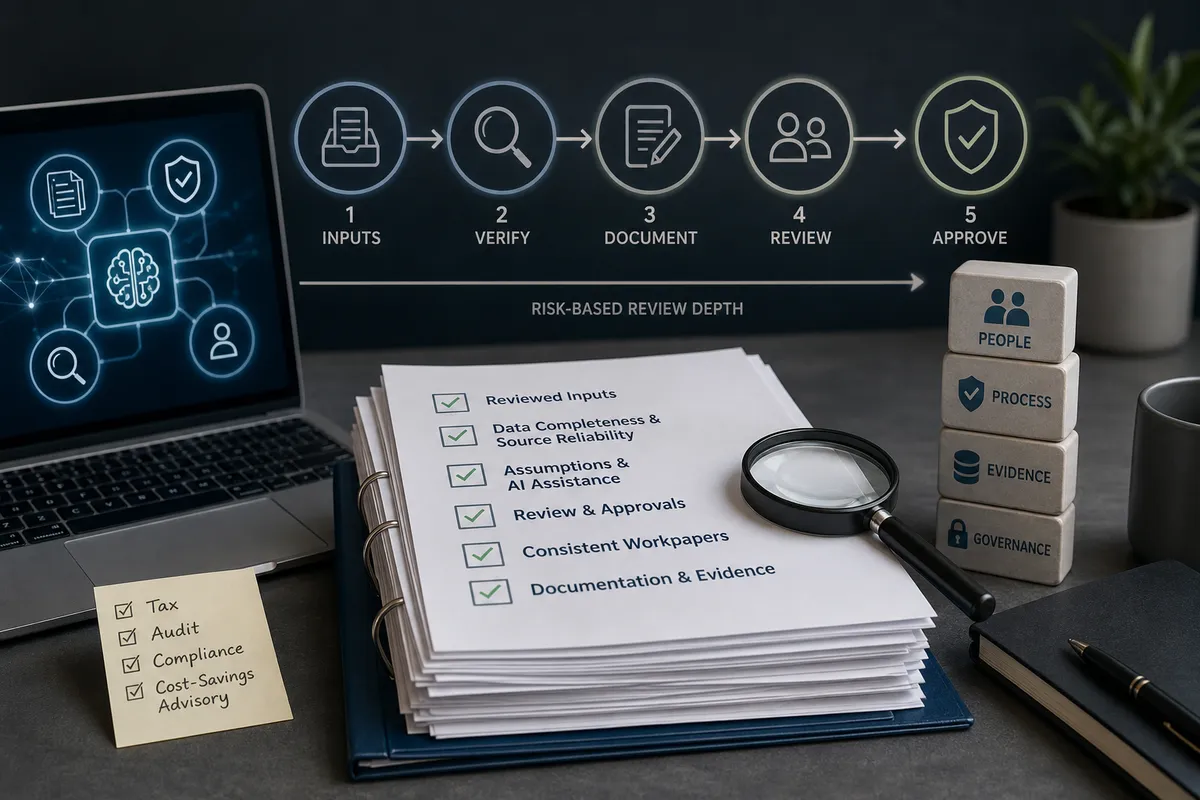
The current evidence supports one practical thesis: CPA firms can begin using AI-assisted advisory deliverables without waiting for a perfect AI governance blueprint, but only if AI sits inside a documented quality-control process. The supported workflow is straightforward. Scope a narrow use case. Start with reviewed inputs. Verify completeness and source reliability before trusting the draft. Document assumptions, AI assistance, and reviewer edits in the workpapers. Apply review depth based on risk, then standardize only after pilots hold up in practice. The sources are stronger on principles than on detailed templates, which is exactly why firms should pilot carefully and document what they can defend.
If your firm is evaluating how AI fits into tax, audit, compliance, or advisory work, use your existing quality-control system as the starting point and map a narrow pilot process before wider rollout.